Wednesday, March 20, 2013

Competition Video!

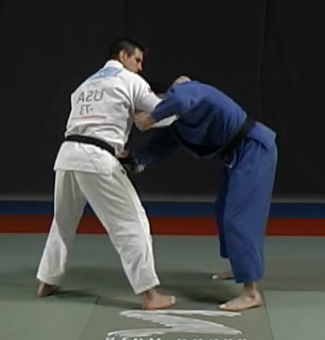
Here's my longest match from this past Saturday (I'm in the white gi). I made a lot of noise in this match, which I'll try to control for future tournaments.


Please leave feedback if you can!

Some thoughts on this match (other than telegraphing my crappy throws by kiai):

I'm happy with myself for being the first one to attack in almost every exchange. During randori I usually play the "wait and counter" game, but Mike Oshima who's an alumni of this tournament gave me the advice to be aggressive. It's likely the case that as my opponents increase in skill level, I'll have to force them to give me openings to attack instead of waiting. On the matter of what I attacked with, I was slightly better in using ashi waza with a purpose instead of randomly kicking at the legs like kyu grades usually do. My opponent even remarked afterwards that I could have caught him with an okuri ashi barai at 3:39 and a de ashi barai at 6:49 had I committed with my arms. I think what makes ashi waza difficult for me is that when I catch someone I don't realize it, so I don't build muscle memory for the movement. Clearly from my style of play in this match, I am equating ippon with maximum effort instead of maximum efficiency. At any rate, I met my personal goal of no shidos.

Next, I'm unsure how I feel about my (non) use of newaza. Since he won by ippon in our first match, I was intent on returning the favor so I kept letting him up. I'm still treating these tournament matches like randori and I don't know what it's going to take to get the concept of shiai to properly sink in. I don't know if I necessarily want to treat me opponent like an "enemy," but if I am going to accept donations and invest all this time/money into training I need to start being more focused on winning. If my older brother (Serra BJJ player and judoka) is reading this, it's not because I haven't been drilling the stuff! Something just didn't click that day- the most prime example is at 2:35 after my score where he is literally lying flat on his back (listen closely- an audience member says "osae komi!"). The only technical flub I had on the mat, as far as I can tell, was the juji gatme attempt at 1:10 where I reversed the position of my legs. I literally just drilled that attack a couple of days before- shame on me.

Finally, my stamina needs work. I've been rowing and biking mostly- probably need to incorporate running, jump roping, and... burpees, which I hate.

Thanks for stopping by! You're alright.
-Ben

Sunday, March 17, 2013

2013 NCJA Tournament Report

I rarely travel with a team, so in order to make myself more comfortable I depend on the kindness of strangers that I meet in the steam room. Something about mutual misery makes people bond, even if they could end up being in your weight class. There were a couple of guys from UT (I think- I’ll have to double check) who let me keep my bag with their stuff, which I appreciated. In exchange I taped their matches, which is a simple expression of mutual welfare and benefit, yeah? I have no idea what it’s like to be an elite judo player, but I try to extend the general “don’t be a jerk” philosophy I use during practice to competition. You don’t have to smile at your opponent (well, I do), but arguing with referees, sticking your fingers in your opponents face, and cranking the neck don’t get you any closer to winning than simply playing the game does. My mat was pretty good, but I saw a lot of head diving uchi matas and medical intervention due to jerk-like tactics when I got a chance to walk around.

Anyway, to the matter of my matches… (1-2 record)

Standard Division Roster: Male, -66 kg 
In spite of having missed a bunch of practices due to school work I felt really prepared for this tournament, as in, the only thing that would stop me from winning is if my opponent was better than me. In what seems like a pattern, this was not the case! This is no discredit to my opponents (who have now become my Facebook friends), but my two losses did not have to do with technique. Here’s what happened at my first match…

First Match (Ghuloum, Michigan State): I get ready to bow and the referee comes over to me and says, verbatim, “If you step onto my mat with that, you will be disqualified.” My heart sunk. The less melodramatic referee comes over and says “Your gi is too small, you have 30 seconds to find a new one.” My proper gi size is a 2.5-3 and the smallest guy I could find with a blue gi had sleeves that went past my closed fists. I hoped my opponent would mess up a drop seionage so I could use sode-guruma jime, but he got control over my sleeves which trapped my hands inside. He took the victory by an uchi mata counter to a kuzushi-less kosoto gari. It was a beautiful technique and will probably end up on this years highlights, so my goal of ending up on the highlight reel might still come true! I was mad- I had gotten that gi on ebay for cheap and it said it was a 2.5. Instead, he sent me a size 2 top and a size 3 pants and I figured it was fine. Dead wrong.

In another showing of goodness in people, 4 properly-sized people came over and offered me their blue gi. This was nice, but because I was the first person to lose I would be wearing a white gi for all of my repechage matches. Speaking of which, my first opponent went on to lose his next match so we had to fight again! 

Second Match (Ghuloum, Michigan State): This match went the full 5 minutes and was basically me trying to return the favor of the ippon from the first match. In a very inappropriate move for a national competition (or any competition, for that matter), I refused to go into newaza even when he hit his head on the tatami and was literally lying flat on his back for 5 seconds. I won by waza-ari from kosoto gari and two shidos. The way I fought was brutish and, in my opinion, very ugly to watch. I hope my future matches are cleaner than that. Mohammad is actually very skilled, he just fought an extra match so I think I out-gassed him.

Third Match (Kumaki, University of Washington): I had talked to this gentleman before and I was actually excited to face him! He was fast- much faster than me. If you can imagine it, he attempted a seio nage. I stepped over to the right, but lost my balance and fell to my knees slightly in front of him. While he did drop to his knees, he got back up (making is nage, not an otoshi) and continued to drive into my shoulder even though I was turtled. This popped something in my shoulder and I grunted because of the shock, but the pain went away really quickly (I think it unpopped right afterwards). The referee instructed me not to move and the medics ran over to examine me. While they determined that my shoulder was fine, because they came over I had forfeited the match. Admittedly it does feel funny now, but I don't think it's serious... regardless, another disappointing end to a match.

The tournament ended with the awards ceremony, with all of the competitors sitting on the mat together. This was cool because we were all the same age and the tournament directors actually demanded that we mingle while they organized things on their end. Striking up conversation with some of the OTC ladies made me wonder what it would be like to date someone who also does judo. What would we talk about when doing judo is the only interesting thing about me? That’s a different universe that I don’t live in right now.

Anyway, I’d like to thank all of the people that have helped my judo over the years and also apologize for not bringing home a medal after all the time/hard work that’s been invested in me! Next time for sure.

Special thanks goes out:
  • My parents for supporting me in everything I do, even if they will always think judo is a dangerous sport.
  • My girlfriend for taking care of my injuries/setting alarms so I don’t miss flights (usually).
  • Sensei Nick Roseto and Sensei Hiroyuki Yamashita for raising me on proper judo fundamentals (and for passing on their taiotoshi). Waseda Judo Club, Inc. (Lynbrook, NY)
  • Sensei Shintaro Higashi and the guys at Kokushi Budo for pushing my competitive judo to the next level. Kokushi Budo Institute
  • Sensei Hans Dudeck for drilling my terrible ashi waza. Biwako Judo Club
  • The Tau Sigma chapter of Beta Theta Pi for hosting me at their house, which was conveniently 2 minutes away from the tournament site, and for chauffeuring me to the airport. Ean is the #1 pledge.  
  • The Friedlander family for their generous monetary support of my judo- I look forward to training with Isa in the fall!
  • Brian Jines and Columbia University Club Sports for making this trip possible.
Next up is blue gi shopping, then the Liberty Bell Classic (April 6-7). A video of my 2nd match will go up in a couple of days, so check this blog periodically. In the meantime, here's a video of the winning Kata demonstration from earlier in the day. I didn't bring my tripod because I was competing, so excuse the shakiness.


Thanks for stopping by- you’re alright!
-Ben

Friday, March 15, 2013

Ben's NCJA Travel LiveBlog

3/15/13

10:00 PM

Conclusion: Iowa is too cold to take video of- I'm hydrating, studying, and get focused for tomorrow!

6:57 PM


12:30 PM


In my little cubicle at Chicago Midway Airport.

12:15 PM

Text from my mom: "Good luck with judo. Do not break bones"

My bones or someone else's? Both have been proven to stop me in my tracks. =P Also, if I was reading this I would probably think "What unwarranted self-importance! Where are his medals and national titles?"

12:00 PM

I realize that many of you were looking forward to a witty video of my travel shenanigans, but in my rush this morning I packed my camera in my checked baggage. (Yes, I have a dedicated video camera.) This will have to do- it may help the experience if you read it in my sweet, chocolately voice.

In case you have no idea what's going or why I'm writing again, I've flung myself back into the competitive judo world with the blessing of my parents and coaches. Part of the sudden motivation is this regret I've been starting to feel about having taken such a long break from judo in general. How good could I have been and how far would I have gotten? Statistically, eh and not particularly far, but entertaining the idea of a successful me has been drawing my ass to the tatami over the past couple of month all the same. Tomorrow I am competing in the NCJA Championship at Iowa State University, while will the biggest tournament I've competed in. This one is actually worth points on the national roster (which at this point, I have none), which I assumed wouldn't be the case given how restrictive the entry criterion are. Regardless, I'm not assuming my opponents will be any different than usual since 60-66kg players are usually on the young side anyway.

Speaking of which, cutting weight has to be the most annoying sport-related practice in the world. Boarding the plane I was 2-3 pounds over my goal weight and I'm definitely going to have to bike/treadmill/sauna when I arrive at the tournament site. I wonder if they'll let me check myself on the official scale. While it seems like I'm generally on top my stuff, I almost didn't make it to this layover in Chicago (which is where I'm writing from). Basically, I underestimated how much 2ish hours in the sauna would exhaust me, so I completely overslept and I had to borrow money from my girlfriend for an emergency cab to LaGuardia. In addition, I didn't completely grasp the fact that having membership in USA Judo vs. USJA vs. USJF actually meant anything until my USJF card was rejected for registration. Basically, try to jump head first into this student-athlete thing has not been as smooth as I imagined. Finally, while I have been granted informal permission to stay at the Iowa State Beta house, I do not have the contact info of anybody who will be able to pick me up from the airport/let me in. Great start, right?

I'm going to go work that out now- I'll probably post more after weigh in's about how much cutting weight sucks and how I deeply regretted not getting a deep dish pizza while in Chicago.

Thanks for stopping by! You're alright.
-Ben

Friday, December 7, 2012

"Higher Judo: Groundwork" by Moshe Feldenkrais

During the manic phases of what I call “manic-procrastination disorder,” I usually end up misplacing my productive energy into judo stuff. At the end of an hour-long binge, I had was a proud owner of a new judo website and a funky old newaza book called “Higher Judo: Groundwork.” The first print ran in 1952 and it had apparently become quite rare, but luckily enough it had be reprinted in 2010 in paperback. You know me and my obsession with ground work, right?

So, who was Moshe Feldenkrais? Apparently, he was a pretty big deal. A pioneer of judo in France who hung out Jigoro Kano, as well being a scientist of sorts, he was interesting enough on his own to convince me to shell out $17 for his book. This was the last in a series of judo and jujutsu literature, meant for experienced judoka. Though I usually like to read the foreword, the 2010 one speaks more about judo as it relates to the development of the Feldenkrias Method—something I can’t even begin to pretend to care about. 

In terms of judo content, “Higher Judo” contains 300 line drawings (traced from actual photos of Feldenkrais and Mikinosuke Kawaishi) with accompanying commentary. Unlike most instructional books that stick to explaining 1 or 2 pictures at a time, Feldenkrais works to tie together different positions, constantly referring back to earlier pages. This has the advantage of synthesizing the work, but is also makes the 200-page book frustrating to read through. Therefore, it may be better said that “Higher Judo” is meant for brown belt judoka and black belt-level readers.

“Higher Judo” represents one of the first attempts by a judoka to capture “proper” newaza instruction in print. There are definitely other instructionals covering newaza, but it seems that the goal of judo print during the mid-20th century was capture judo through a series of photographs. The line drawings lack color, which is a choice probably made to draw your attention to the text. Even if you are a visual learner, the best photography of the 1952 was not that good, such that the crispness of the line drawings is actually superior from an instructional standpoint.

In the paragraph above, I put quotes around the word “proper” newaza instruction because it seems to be the least standardized part of judo in proportion to how often we have to deal with it. The fact that Feldenkrais, an apparently reknowned grappling expert and contemporary of Kano, poured so much detail into this book is very interesting. I say this because I’ve never seen judo newaza taught in his terms, which reinforces my idea that unlike tachi waza, the judo community have yet to place a standard on the whole of newaza technique. There are a set of techniques required for grading, but the proper application of ju on the ground deserves more attention than it currently gets. The positional nature of newaza lends itself well to didactic instruction, which is exactly how Feldenkrais attempts to teach it. Here is the table of contents:
Example of "Higher Judo" Content

1. Judo Practice…17
2. Uniqueness of Action…42
3. Where We Start and Why…46
4. Principles of Ground Work…53
5. Some Useful Exercises…56
6. Ground Work Tactics…67
7. Starting Ground Word…77
8. Six O’clock Approach…87
9. Right or Left Approach…121
10. Head On Approach…160
11. The Astride Position…181
12. Opponent Facing the Ground…207

Sometimes I think that judoka have this illusion that they’ll open a book by a pre-WWII black belt and find the entire catalogue of modern Brazilian Jiu Jitsu techniques which, quite frankly, is ridiculous. The farther you move from the founding of Judo, the more you can see how the sports have evolved into totally different things—for better or worse. Even if you have no sense of historical accuracy and think that BJJ comes from Japanese Jujutsu, what people are doing in modern competitions does not resemble old school, “true” Gracie Jiu Jitsu (as Relson Gracie will gladly tell you).

Anyway, as a grappler you should not be looking to “Higher Judo” for the answer to your ne waza woes (which can only be solved with more practice). It serves as a historical piece and has a lot of great ideas concerning the general approaches to groundwork and principles that guide them. More importantly, as students who hopefully will spend time amassing experience and knowledge to become teachers someday, “Higher Judo” shows what happens when a smart person really thinks about grappling in-depth, as a science. His work is imperfect, but given the time when it was published is was far ahead of its time in that it recognized problems in instruction and the practical application of classical techniques. If you can get past the foreword and the constant plugs for the Feldenkrais Method, “Higher Judo” can be a great tool for the further development of your judo. 

Link to buy:

Thanks for stopping by! You're alright.
-Ben

Saturday, November 24, 2012

About Atarashiido.com!


The company logo.
A few weeks ago I sent out invites to a Facebook page called “Atarashiido – Judo by Judoka” and I thought it would helpful to provide some context! The idea is to centralize high-quality judo media, driven entirely by reader contributions. There are millions of judoka in the world with interesting stories to share—it’s not just the Kimura’s and the Mifune’s that matter! “Ju” is a concept that can express itself in many different ways, from tournament performance to personal conduct. Unfortunately, meaningful content gets lost among the dribble on forums and YouTube, to the extent that people begin to associate those awful things with judo culture. Ultimately I want to help change the face of judo online, since the Internet is an integral part of the life experience of the modern judo players. The average person will inevitably attempt to supplement their training with online materials.

Search box blocked by control panel
dropdown on JudoForum, 11/24/12.
The natural question at this point is “Aren’t there other judo websites online? Why should I care about this one?” First and foremost is the aesthetic quality of the current batch of judo websites. From coding errors to poor design motifs, they make me less likely to stick around and enjoy the material. Certain forums are so poorly maintained that they are host to malware, which creates a cost-benefit scenario that doesn’t work in their favor. A deliberately simple design will reduce the need for maintenance, as well as allow reader to focus on the content. No clip art, no terrible stock GIFs of the Gokyo, no broken search boxes… just judo.

Next, I’ve found that even the best online judo personalities tend to run out of things say rather quickly. If you’re talented, you’ll be able to master one, maybe two techniques in your lifetime, meaning that it will be impossible to constantly put out high quality material on a wide variety of subjects (like many people attempt to do). Because we’re drawing on the wealth of knowledge of entire community, we will be able to post original and diverse content on a regular basis, something that I have not seen in my many hours of online perusing. The staff will take on an editorial role, to work with contributors to maintain the quality of our website.
I can't even... JudoInfo 11/24/12.
So, how can you help? If you’d like to contribute an article or video, simply e-mail:


If you’d like to volunteer to help code, design, or be an editor, please e-mail:


Thanks! The website launches on New Year's Day!
-Ben
Our current design.


Tuesday, October 23, 2012

Hudson Judo Promotional Tournament Report

Sorry this is coming so late, it's midterm season at Columbia.

Saturday, October 13, 2012

Today the Hudson Promotional Tournament at Tech Judo, to advance to nikyu through Batsugun. Two decisive victories in a row against other sankyu’s was all I needed, which on paper didn’t seem that difficult. The fact that my time in grade (2.5 years) is over twice as long as the “recommended” time in grade for this promotion for non-competitors honestly made me feel like I was sandbagging a bit. I've also technically been judo-ing for 13 years... I’ll get back to how wrong I was later.

After my shift running dorm security I took a subway down to Port Authority where, of course, I ended up getting lost. I run around MTA every day, but somehow I couldn’t handle New Jersey Transit? Luckily the bus to North Bergen was a full 20 minutes late, so a full sprint up a few flights of stairs put me a train in time to get there an hour early. Earlier in life I remember tournaments running extremely inefficiently, as in parents yelling at the tournament directors, heavy weights ending up in kid divisions, and score boards malfunctioning. Billy Martin and company ran a very smooth tournament, and if that is the standard for Hudson tournaments now I’m extremely impressed.

Once I confirmed my attendance and looked around, I felt a sweeping sense of “other-ness.” There were big groups of people from other clubs there, shooting the breeze and warming up before the tournament. There was interclub mingling going on that I wasn’t part of because I didn’t know anybody. Eventually I found my courage and re-introduced myself to some guys from Oishi Judo—they were nice, and remembered me more for being that kid from Madagascar more than anything. Even with some social capital, I was still awkwardly doing stretches and plyometric exercises by myself to warm up. After way too long of doing that, Billy Martin roared and everyone lined up. He gave a nice speech about positive Judo, which I appreciated.

Being at the bottom of Judo totem pole, sankyu and 66 kg, my matches were one of the first. I think I was 3rd lightest at the tournament, which is pretty good! I thought I had let myself go. Anyway, my first match was against a fellow from one of those trendy MMA schools that does a little bit of everything. He had a Brazilian flag on his arm and his judogi was oddly textured, so I deduced that he was a primarily a BJJ player. We bowed and he took a low defensive stance, which I knew I was going to end up using sumi gaeshi to deal with. Initially I got a wazari through de ashi barai and ended up in his guard which, honestly, I didn’t feel like trying to pass. My goal was to save energy this first fight, so I fended off a couple of juji gatame attempts and stood back up. I don’t know if my arms are incredibly weak or I just suck, but my arms were already tired. We got a very generous amount of time in newaza for the one exchange, which made me happy inside even though I didn’t actively participate in it. Anyway, win by sumi gaeshi.

Next up was a gentleman who grew up doing sambo and wrestling in addition to Judo. How do I get stuck will all of these ground competent people? Was Billy Martin playing a trick on me? In this match, I got outgripped and wasn’t able to land him on his back. I probably could have been a lot more physical because it (would have been) my last match, but I wasn’t thinking properly at the moment. I realized that I just wasn’t used to the adrenaline—my focus was so bad that I couldn’t even complete a koshi jime (clock choke) because I couldn’t remember where I was supposed to put my other arm. We ended up drawing, but because I had to win two in a row it counted as a loss for me.

I bowed off and got some encouraging words from the audience, that I fought well and looked better than my 2nd opponent out there. My first opponent even asked me to show him the technique I threw him with! People were very friendly here. After relaxing for about a minute, I realized just how tired my arms were, how bad my cardio is, and that I wouldn’t be able to do two more matches if I didn’t do something about. I tried to do so yoga on the open mat, but that didn’t really help. Oh well. Before I knew it, we cycled back to me and I hopped up for another match.

This time, it was a taller brown belt from Oishi (I think). This entire match was a blur, but I think I ended it with tai otoshi after about a minute. It was extremely embarrassing being as tired as I was, but the tournament doesn’t wait for you to catch your breath. The next guy was literally the lightest guy in the division, who I tossed around for 4 minutes and got ¾ of a point (I think). He was pretty good at spinning out of normal angles, so I decided to try yoko tomoe nage. With a minute left, and ¾ of a point lead. Stupid stupid stupid. He dodged it and pinned me with kesa gatame. I was literally gassed and only managed to work my way out with about 3 seconds left on the osaekomi clock, so I lost. Dammit.

from judoinfo.com
Although I didn’t get thrown and threw all my opponents repeatedly, I still wasn’t able to win two matches in a row. I was a little bit frustrated, but I think in this situation it was a case of my opponents (and new friends) being much better prepared than I was for the tournament. Better cardio and safer throw choices would have been my friend, which I’ll keep in mind for my next tournament in a few weeks. Unfortunately, none of the guys I faced advanced either! I guess we’ll do this again in spring. I definitely need to work on my mind set for competitions. I also got a video camera, so I’ll be able to put up videos of my other tournaments.

Thanks for stopping by! You’re alright.
-Ben

Saturday, October 13, 2012

Batsugun tomorrow! First Judo tournament in two years.

Hey loyal readership,

It's the night before the Hudson Judo Promotional Tournament and I'm feeling a bit of anxiety. On some level, I thought that I had mentally outgrown caring about rank- after all, I've been wearing my brown belt so long that the caked on dirt and blood makes it look black anyway. That said, even if I did care about rank I'm (theoretically) only moving from sankyu to nikyu, so what's the big deal?

I think that part of me, after taking such a "long" break (percentage of lifetime-wise) from Judo, is afraid that I've wasted my potential in regards to becoming a great judoka. Yes, I know that Judo is primarily a form of education that uses physical activity as a way to express it's philosophy, BUT, at least for me (and what seems like a large portion of the modern Judo world), success in shiai has always been a strong desire, if not a driving factor in the practice of Judo. Realistically though, I have a lot of catching up to do. I have very little doubt in my mind that at least a couple of those extremely talented players from my youth is now doing greater things than I am now. That's exactly what they are now: great. Note, that "great" is distinct from "talented" or "prodigious"- rather, through diligent practice they have realized their potential. That's scary to me.

Regardless, (like my ability to do taiotoshi) the dream of one day being in the Olympics or a World Championship has never left me. In spite of how scared the thought of going against people more experienced, bigger (open weight), and taller than I am, I think the best course of action is to just try my best and see where it takes me. I'll write about my experience tomorrow!

Thanks for stopping by! You're alright.
-Ben

Tuesday, June 19, 2012

Basic Tachi Waza Tactics: Posture

This summer I've been cross-training BJJ and I've really enjoyed it! What I appreciate most is that basic deficiencies in ne waza, such as the ones that I tend to demonstrate, are consistently punished by white and purple belts the same. Obviously the method by which one player deals with their opponent's mistake varies among individuals, but you learn very quickly where not to put your arm. The sport as a whole seems easier to grasp at its earlier stages than Judo, since certain positions appear more frequently and persist longer than, say, the split second before your opponent shifts all of his weight to his leading foot. Once upon a time, ne waza was taught to young judoka before tachi waza in part because of this learning curve. Mats also sucked once upon a time, so it depends on which anecdote best fits the narrative.

credit to http://www.multiply.com
Infrequent use of timing-based techniques in shiai like de ashi barai points not to the lack of utility of such techniques, but the difficulty of their mastery. Part of the reason why I think we see so many attempts at "drop" seoi-nage is because the position of tori's body is easy to understand- low. The problem with waza whose body placement is easy to understand is that judoka become complacent with simply placing themselves in such positions and expecting the throw to work, without considering the proper application of kuzushi or the finishing action of the throw (kake). How many times have you seen somebody attempt a tomoe-nage against someone standing still with good posture? I've seen too many to count, and more than half of the botched techniques were done by me!

Anyway, if you're not familiar with italicized Japanese terms above that's fine. Their meaning is not the point of the article, nor is it something that I have the intellect to articulate properly at my current level. Regardless, in my experience of teaching, as well as through watching my BJJ friends struggle immensely with tachi waza (standing technique), I have come to realize that it is absolutely impossible to understand standing Judo technique without first being taught the basics of movement and posture. While not comprehensive, here is the first of a series of articles that can help new players avoid being thrown due to lack of fundamentals, as opposed to their opponents working to create an opportunity for the skillful application of waza.

I. Poor Posture 
credit http://www.themat.com
I've seen it so many times from people transitioning from other grappling arts and it is a fairly difficult habit to break. Judo culture tends to type cast wrestlers with this habit, when it reality there is no sane stand-up system that teaches poor posture to its students. I'm no nuclear astro biomechanical engineer, but a little birdie once told me that a stable posture is one in which a person's center of gravity (i.e. crotch), falls in the middle of their base of support which, in the context of standing, is the space of any limb touching the ground. Notice that I say "stable," not "proper."

One of the reasons this concept can be difficult to teach beginners with a bit of background in grappling is that they believe "proper posture" means standing up straight, which it does not. The question "If I stand up like that, won't I be vulnerable to a double leg?" is asked so much because the concern is justified. Not all stable postures are created equal, as can be seen in the difference between the effectiveness of a hand stand and a basic right-handed stance in a fight. If it is not clear one is much more likely to fall over with the same amount of force, due to varying degrees of "conditional stability." As martial artists ultimately interested in the application of ju or "yielding/gentleness," the positions most favorable are those which allow for quick adjustment to any force applied to us, as well as not providing an easy means through which our opponent can take us off balance. In other words, a posture which is not easily be broken, but allows for the freedom of movement to readjust the center of gravity if it has or will be shifted.

Head Position
Due to the curious way that humans evolved, we have big heads. As one of the three points farthest away from the center of gravity, the other two points being the feet, as well as the only one unaffected by friction, the head potentially has the greatest effect on balance. Luckily, its vertebral range of motion is limited to a few degrees in every direction except the forward. That said, a head looking down at the floor provides a combined mass, including the cervical curve, of about 15 pounds which is more than enough to drastically increase the effectiveness of any throw requiring a forward pull or, more simply, the effectiveness of somebody pulling an opponent straight down in an attempt to engage in ne waza. To be short, the general rule is "keep your head up."

Besides increasing the opponent's ability to complete a throw, keeping a low head is also a great way to allow the other person to advance their grips. Without the head with a hard pull downward there is a clear path to grabbing the belt which provides the impetus for a multitude of high percentage techniques, especially sumi gaeshi and its variations. This is the case on the ground too, where allowing easy access to the back and neck can result in threatening chokes like a guillotine/mae hadaka jime, or Okano's variation on okuri eri jime, seen below.

Spinal Curvature
If I haven't beaten this point to death, being bent over isn't necessarily "bad." In the extreme cases where there is a 90 degree angle between the legs and the torso however, it is "bad Judo." What that means is that it is an overly defensive posture, with no intent to attack. What's most frustrating to me is to see two people take that exact same pose- at that point, there is no longer any reason to continue the fight standing because neither person is in any danger of being thrown. So assuming that this situation does not involve two wussies and instead involves two active participants, each person ideally wants to be bending from their waist, not their spine. One, making this a habit in both life and Judo is a long-term set up for scoliosis. Two, most, if not all, forward throws like morote seoi nage (which happens to be one of the only two throws I consistently do well) benefit from the extra space provided by a curved back. It's also no coincidence that it is difficult to keep the head up if the spine is curved. Therefore, in standing you must always "Keep your back straight!"

Conclusion
Which one of these guys is "winning?"

Thanks for stopping by! You're alright.
-Ben

Friday, August 19, 2011

Fall Judo Plans

Dr. Dad suspects minor MCL tear.
Since I'm stuck in bed for a few days due to an embarrassing ukemi-related injury, I figured I might as well use the time to think about Judo this Fall. Not just how often I'll be practicing, but what my goals are and where Judo will fit in my life now that I'm heading back to school. Summer is when we try as hard as we can to be the person we've always wanted to be. You know, the person who diets and exercises. The person who takes walks in the park when the mood strikes. The person that keeps in touch with old friends and family. Catch my drift? Those old slogans for "how to live a better life." In my case, this amounts to making every practice, every tournament, and really being there without having a 1,000 other things on my mind. It's a challenge- not like drought or famine or anything- but a challenge nonetheless.

Being a full-time student is a full-time job. A full-time job is also a full-time job, but hear me out. I'm very aware that what I have now, as a devilishly handsome 20-year-old Ivy League student, is the best situation I'll ever have. I don't know what a soul mate or child's laughter will bring, but as far as the amount of work I have to do vs. the amount of time off I get for it, I doubt that ratio will get better with time. What's scary to me is that even though I don't have mortgage to pay, kids to feed, or white picket fences to maintain I still have trouble finding time for Judo in my life. It's definitely not enough for what I want to achieve to go hardcore over the summer and then slack the rest of the year. Definitely not, but that's basically what I've been doing since I came back from my hiatus.

You know how when New Year's is around the corner and your inner monologue starts every other sentence with "This year will be different..."? I'm having that time now, even though I'm one of those cynics that will roll his eyes and say "Why not last year or the year before? You're not going to do it." That's a fair thing to say on my part, but I really hope that this (school) year is the year I can do it. I'm scheduled to teach 2 classes per week and "learn" one class per week at the Columbia Judo Club. That's one more than I did last year, so that should be good. I'm also planning to join the BJJ club (hopefully for a discounted price because their students crash my classes indiscriminately), and find a gym buddy to motivate me to start lifting again. I've planned this so I have people I depend on and people that depend on me to improve my technique and my conditioning. I'll let you guys know if this works out! School also happens.

Here are a list of tournaments I plan on attending in the next couple of months, Senior Men's Brown Belt <66kg for all.
  1. September 18th: 45th Annual East Coast Judo Championship - Newark, NJ
  2. October 2nd: 2011 Garden State Judo Classic - Wayne, NJ
  3. October 9th: Princeton Judo Invitation - Princeton, NJ
It's not annoying always going to NJ for tournaments or anything! Message/comment if I'll be seeing you there. I'll have photos/videos up, so look forward to some real content then.

Thanks for stopping by! You're alright.
-Ben

Monday, August 15, 2011

The Final Destination

Not a review of that awful movie series, sorry!

So here we are, at the end of my convoluted series of newaza articles. It's been a fun journey right? After all of the build up and time between posts, my solution is frustratingly predictable: cross-training in Brazilian Jiu-Jitsu (BJJ). Practicing a groundwork-focused fighting style if your groundwork isn't good enough? Brilliant Ben! Self-deprecation aside, there is some real thought that should go into this... While I refer to the general case of "groundwork-focused fighting style," I specify Brazilian Jiu Jitsu. This is the most logical choice for a judoka seeking focused newaza practice. Why? First of it, due to the rise of Mixed Martial Arts, schools are popping all over the United States and Canada. More importantly, BJJ comes from Judo so it's principles are the most compatible with the way a judoka moves and thinks. Off-balancing, efficiency, leverage, posture, position. The fact that both judokas and BJJ players associate those words with their style points towards this unique relationship and the ease with which one side should be able to train in the others'.

Any person who has spent more than 2 weeks in a dojo has come across the guy who "did some wrestling in high school and was pretty good at it." Even those types who are able to hold their own eventually get a "Fix your posture!" from Sensei, to which they respond "Sorry, I learned not to expose my legs." He'll fix it momentarily then a few minutes later will bend over again, causing frustration for everyone else on the mat (dramatization). What's working against this student are the incongruities between Judo and Freestyle wrestling. Freestyle or folkstyle? I'm not sure what they call it in high school, but cross-training it with Judo is demonstrably more difficult than cross-training BJJ with Judo. The posture is different, there's no gi, the definition of a pin is much more narrow that what constitutes a hold-down in Judo. Doing both isn't impossible (in fact, many top American Judoka wrestled in high school/college), but why not go for the easier transition?
He'll never tap!
This all seems simple enough, but one should still approach cross-training with caution. Again, I stress the importance of congruency. "Judo" should pair well with "BJJ," but the names are brands that anybody above a certain rank can use as long as they fill out the paperwork. This isn't necessarily me discrediting the 10's of thousands of teachers out there that I haven't met, it's just that there is clearly a difference in the way some choose to interpret the "ju" (gentleness) in "judo" and "jujutsu." If a sensei teaches you to muscle your way through a poorly timed throw, he's teaching you something- just not Judo. If a BJJ teacher tells you breaking closed guard is all about arm strength, he's teaching you something- just not BJJ. I'm not advocating going up to Sensei and challenge him to mortal combat to test his legitimacy. Not only is that rude, but the typical person seeking even intermediate level instruction isn't qualified enough to make that judgement. However, it is appropriate to be wary if your BJJ and Judo instructors are teaching you completely different concepts, when the two are supposed to be closely related.

While I definitely have more to say on this topic, I think I'll get off it for a while. I want to vary the content and style a touch more, but if you have any questions feel free to message me.

Thanks for stopping by! You're alright.
-Ben

Monday, July 11, 2011

What is Kosen Judo?

Hey guys, I was in the middle of continuing my newaza segment when I realized that there is an unreasonable amount of ground to cover in just one post. When I read articles on the history of Judo or Brazilian Jiu Jitsu they always amalgamate their shared history into a few short paragraphs. Worse than that, they tend throw in a bunch of terms in italics, as though to say to their reader "Screw you, Google it!" In today's scary world where proper nouns double as verbs and attention spans are short we have to consider the consequences of just saying things without explaining them. In cases where a writer is presenting their interpretation of history as canonical, partial information is as bad as false information. For example, in my original piece I was just going to throw in "Kosen Judo" with a tiny blurb after explaining what it is. Limiting that explanation to a footnote seems to imply that the context it brings to the discussion isn't all that important, when it really is.

I'm sort of doing it here to some of you, but for those who know who Mitsuyo Maeda is look at how he's typically treated in the founding story of BJJ. He almost never gets a proper introduction— Maeda becomes this random figure who teachers the Gracie family how to fight for a while, and then through their own genius the Gracies become really skilled at newaza. One has to ask however, what the hell was Maeda doing in Brazil in the first place? Which of the Gracie kids did he actually teach? All of these details reveal something valuable about the history of the sport. Maeda was one of the Jigoro Kano's delegates sent around the world to promote Judo, which at the time was just starting to replace the name "Kano Jiu Jitsu." What does this say? For one, it says that anybody who claims that Brazilian Jiu Jitsu comes from traditional Japanese Jiu Jitsu is full of it. Not only that, it shows that the techniques and principles of BJJ, in fact, come from Judo! If one reads one of those short histories of BJJ, what tends to happen is this over-glorification of individual fighters. Sure, the Gracie family is full of genius and hard working people, but it is the combination of that and being able to build on a well thought-out system of martial arts that made them successful.
 
But I digress.

What is "Kosen Judo" and why does it matter in my quest of trying to "find" newaza? Trying to avoid anecdotes and provide actual facts, Kosen Judo is "regular" Judo, taught at 5-year "kosen schools," that emphasized ground technique. During the early 20th century, the technology for mass-produced mats was simply not good enough to project people from the high velocity impact of a committed Judo throw (even today injuries at the beginner level are fairly common). As a result of this, instructors spent most of their time practicing newaza and eventually became really good at it. They were good not only in the sense that they excelled at the skill itself, but they were also able to win competitions against judoka who were taught in the traditional way, forgoing throws completely. Basically, they would pull guard (hikikomi), which means to fall backwards and pull an opponent down between their legs in order to start mat work without being thrown. There was no rule against this until 1925, when Dr. Kano… made a rule against this. One possible explanation, perhaps the most logical, is that Kano had envisioned Judo being a system that used both standing techniques and ground techniques, and didn't want one being taught more than the other purely for success in competition. There are principles of tachi waza that don't have a ground equivalent, and given the amount of though Kano put into the system I'm not surprised that he would be a little miffed that they weren't able to executed in shiai! I would go as far as to say that the concept of BJJ and Olympic style Judo would disappoint him, a lot.  

Regardless of official rule changes, the Kosen style of Judo persisted and didn't change its format for its own tournament, which is why it is relevant to me. They represent what Judo players could accomplish if they spent as much time drilling mat work as they did doing uchikomi. Today Kosen judo, that is schools that have teachers with lineages in Kosen judo, is only practiced in what were the Imperial Universities of Japan. It is wildly impractical for me to travel to Japan and check up on them, but somewhere inside I like to believe that it's this parallel universe to BJJ schools, where the passion and rigor of newaza has not been lost like it has in the United States. That would be great! There are a lot of judoka that are credited as being great on the ground, but often that is the result of them having a strong wrestling background and is not necessarily Judo. I've learned a lot of great things from Greco Roman wrestlers, but it's not Judo. It's not as though I'm a Tae Kwon Do person going "Where's my mat work?" I'm a judoka— Judo, by definition, includes mat work and if I'm not going to Japan to learn it, where will I go? I'll save that for next time. Here's a video from a DVD set on Kosen Judo, bare with the cheesy music.
 Thanks for stopping by, you're alright!
-Ben

Tuesday, June 28, 2011

Jason, the Boxer

This wasn't supposed to be the next segment, but as I sit here in bed with a sore face and cut up mouth I felt like I had to relay this story to you guys.

To be frank, I'm not a gym person. With the limited amount of time in my schedule, I think my time is better spent training martial arts than just training my body. If I had the time and didn't feel as though Judo practice wasn't already a work out, maybe I would be. There's also something odd about a 5'4" frame supporting a massive frame, but that deals purely with aesthetics. Regardless, after many years of resisting it, I finally went last night to Synergy with my friends. I figured, you know, why not? I might like it.

Walking into this tome of a handful of women in track shorts and sports bras and a lot more men exuding a desire to be more masculine than the man working on the machine next to him, I had mixed feelings. The drive was already made, so I hopped on the most logical machine for a Judoka- the ergometer (or rowing machine). After about a half hour session of that, I decided to do some plyometrics around a medicine ball which kept my cardio going. Eventually, in my quest to avoid actually lifting anything, I came to the punching bags and let loose a couple of roundhouse kicks because that's just what guys do. Big mistake. (Or plot device, whichever you prefer.)

Pretty much out of nowhere a gentleman comes and says "Hey, you've fought before huh? Let me see your stance bro."

Being the pretty cool guy I am, I didn't brush him off and assumed my stance, something I haven't said since I took Karate over a decade ago. Pretty much as soon as got my hands up he shoots a straight right, barehanded with a ring on right into my jaw. He said my stance was all wrong and put in one I could recognize right away. He was a boxer! I was little miffed about being clocked in the chin for no reason, but he quickly apologized. His name was Jason, and for some reason he decided to give me a crash course in boxing for the next 40 or so minutes. Apparently his uncle was a professional boxer and his cousin runs the Gracie Barra school in our town, two claims that I didn't care to verify. What stood before me is a person enthusiastic about teaching, which is just nice to see. This entire gym was watching us spare (watching me get punched in the face several times). I tried not to reveal my martial arts background by grappling, since I wouldn't have learned anything if I did. I took his advice, philosophy, and accidental hits to the face and went home, having not lifted a thing. That said, I don't know if I'll be going back to Synergy!

I think the moral of this short story is, no matter how awkward or random a lesson may be approach it with an open mind. I'm sure as hell not going to become a professional boxer now, but there were definitely snippets of wisdom in our impromptu sparring session. Even if you were taught to do something a different way, play the part of somebody that knows nothing. Afterwards, take the time to think about why that style does what they do, see if it makes sense, and then try to incorporate it into your repertoire.

Thanks for stopping by, you're alright!
-Ben

Sunday, June 26, 2011

My Terrible Judo Guy Newaza

Now that I'm back from university I've been practicing at my home dojo which, of course, means I get to see my older brother more often. He got me into Judo when I was little, but he practices BJJ also. Not surprisingly, pretty much every time we roll he berates me for my newaza (lit. "ground technique"). I'll be the first to admit that I totally deserve it! For the decade I was doing Judo before college, I was never challenged to step up my newaza to the same extent I was challenged to step up my tachiwaza (lit. "standing technique"). At this point in my life, as I'm working towards competing at the highest levels I see exactly why this is the case.

In the heart of every modern Judoka there exists the desire to do at one of the following: 1) to be successful in competition 2) to contribute to the success of another person in competition. To cater to different tastes/philosophies there are a handful of tournaments that break away from the IJF's rules, but let's be honest here- the only tournaments that really matter are the ones sanctioned by the IJF. One of the most notable achievements a judoka can have under their belt (so to speak) is to go to the Olympics, and there is absolutely no way to get there that would allow one to circumvent the IJF (for more details about how spots will be allocated for the 2012 Olympics click here). Even if it was possible, the rules at the Olympics are always set in place by the IJF with maybe a couple of minor modifications.

For my non-Judo readers, the big deal with all of this is that for a multitude of reasons, the IJF's rules favor victory by use of throws rather than by submission or pin. That is not to say that people only win by throwing, but the fact that shortly after engaging in newaza (I guess you could call it "wrestling") competitors are stood up to start the fight standing again. Furthermore, a lot of take-downs that have a higher percentage of starting groundwork than ending the point by a throw were banned recently. My main problem with this is that it disadvantages those who have as much of a methodical, patient approach to groundwork as they do to standing technique. The whole turtle-posture to run out the clock as soon as someone hits the mat is probably one of the most disappointing things to see from a high level combatant (well, that and pulling guard from standing).

In spite of what Judo may be popularly perceived as, groundwork is just as big a part of what Judo was intended to be as throwing is. If you look at, say, Sambo or Brazilian Jiu Jitsu, the principles governing their ground techniques are Judo in origin since both Vasili Oshchepkov and Carlos Gracie were taught DIRECTLY by Judoka. Undoubtedly, the rules of a sport's highest competition will dictate what is taught at its lower levels. Because of this, the emphasis in most Judo schools (including my own) is on throwing rather than mat work. To what extent should teachers spend time teaching the traditions of Judo, versus what will work in competitions?

Right now in my Judo journey (which is really more a life journey) I'm trying to improve my mat work. It seems simple enough, but I've basically made the claim that my own dojo does not provide an environment where my newaza will develop to the same extent my tachiwaza has. In my next segment I'll discuss possible solutions and my take on the various mysteries and myths surrounding Judo and its ground technique. I leave you with a counter argument against Judo players being bad at newaza.
Thanks for stopping by! You're alright.
-Ben

Thursday, June 23, 2011

Judo is not Food

On Blogspot, there's a little tab that says "Stats" where you can see how many hits you get over any given time frame. The numbers on this number are sad! I got more hits per day on my retired cooking blog than I've gotten over the past month on this one. Someone actually had the gall to e-mail me and tell me to "Stop writing about boring Karate stuff and write about food again! xoxo" While the xoxo provided me with some temporary comfort, I asked "Who does this person think they are?" Their comment seems to imply that I should stop writing about something I care about so I can amuse more people. That's a bit presumptuous isn't it? I don't have an obligation to entertain the masses with this, nor should people feel as though they should be entertained by this. However, I've heard this comment before... why?

My theory is that people like things that make them feel smart. Food blogs are the most popular non-celebrity gossip blogs because everybody eats- you can make something with chicken and a spice and every comment basically reads "Wow I eat chicken too! Why didn't I think of that?" There's a familiarity that people crave because they don't want to feel completely ignorant. (Yes, this is insulting.) But it's why you see some bullshit study on the Yahoo! News feed, like "Eat this! Not that!" pretty much every day. People eat that shit up (pun). I read food blogs too, I'm not saying not to. The problem comes in when people chastise publications that have no relevance to them, as though not putting those cliched articles is a failure of internet media.

I'll relate this apprehension towards unfamiliar things to a real-life example. Two of my very good friends are "athletes" in the sense that play can play 5 or so sports on the D4 high school level. I spent most of my life doing Judo, so I'm even worse that they are. However, when they go out and play football or basketball I join in for the fun of it. It's been this way for the past 7-8 years and I thought it would be fun for a change to take them into a Judo class so they could see what I've been up to the majority of my life. They literally looked at me and said "Hey man, I don't want to even try something I know I'm going to be bad at." To me, that shows a lack of open-mindedness and just a shitty attitude towards trying new things. It could also be a lack of testicles, who knows.

So here's my schtick: Judo is not food. Some people will just never be interested in what I write about, but there are people who are and their opinions matter just as much. Just bare with its existence- if you don't want to read it, don't.

Thanks for stopping by, you're alright! (sarcastic)
-Ben

Tuesday, June 14, 2011

American Judo Infrastructure

Judo carries this interesting dichotomy of a sport and a martial art. If you've ever read The Souls of Black Folk by W.E.B. Dubois*, this is sort of the same deal as "double-consciousness," where two different labels on a single object prevents that object from fully becoming either of those things. There are perceived aspects of "sport" that are contrary to "martial art" and perceived aspects of "martial art" that are contrary to sport, which is why I believe that Judo has struggled to maintain growth in the United States.

One of the big problems that Judo has in the United States is that it is still perceived as foreign. The mysticism associated with martial arts works against its marketing as a sport for American children, even though it is definitely one. Judo is rarely introduced alongside football, basketball, and baseball when kids go through that try everything phase. Why does this matter? While Judo definitely values its late-bloomers, having a strong base of young competitors is the key to success, both financially and in tournaments. Adults tend to be on and off with practicing, but young practitioners provide a more reliable source of income because of the parents' influence. That doesn't really answer my question, because couldn't we just market towards children? I say, definitely not. At that age, parents want their kids to fit in and kids want to do what their friends are doing. Judo needs to be casually brought in as an option so it seems more "normal." I can say, without a doubt, that doing Judo in lieu of baseball or football has alienated me from my friends. I still feel the effect even as I enter my 20's because they can talk about these sports with each other while the amount of people I can talk Judo to is very limited.

To examine the state of Judo in America more closely, let's isolate ourselves to the United States (obvious), considering Judo to be an American sport that's not living up to its full potential. Can we do that? Judo doesn't exist anywhere except the United States and it's not growing as fast it should be. Well, for one we can see that successful sports in the United States tend to follow this progression: first the lower levels, then the high school level, then the collegiate level, and then the highest level. To clarify this, baseball would be little league/middle school team, high school team, college team, then the MLB. What does Judo have out of these? Judo has a large range of low level up through high school, a poorly developed collegiate system with less than 20 universities being represented, and national competitions. Remember, the Olympics don't count because Judo only exists in America.

How do we make the infrastructure of Judo more like that of other sports? I think the most logical way is from the bottom up. By introducing Judo to children at the same time as other American sports (as I suggested), local clubs will have more attendance. In the best case, the club won't be able to accommodate the wave of youngsters. This will force expansion, and will also justify employing more instructors and charging higher rates for instruction. Even if every town won't have a Judo club, the bigger individual clubs will have enough resources (people) to travel and compete against each other. There is definitely a difference between the distances parents will travel with a team versus just their own child. A team of a few strong players may look great on paper, but having a lot of people of all skill levels attending tournaments contributes more to the feeling of togetherness within a dojo and, in my opinion, is very much the spirit of Judo. If new generations of kids are getting involved every year, naturally the state of the lower levels of Judo will improve.

From there, what happens? Part of the draw of sports in America is that in addition to long-term goals (Major League for Baseball), there also a lot of intermediate goals to look towards (Varsity teams). If the local clubs become strong enough, I actually don't think that it's necessary for Judo to try to penetrate the high schools. Regular competition and engagement with people their own age is enough to keep people interested their whole life. A truly successful Judo program should produce people who, when applying to college, ask themselves "Where's the nearest Judo club to campus?" I grew up with a nice, wholesome grappling experience and when I went off to college I missed it so much that I co-founded Judo Club! Moving back, I mentioned how I thought that NCJA (National Collegiate Judo Association) is underdeveloped.  I think the organization itself is great, but it simply does not have enough participating schools to sustain its activities. A step that I think would be successful in fixing this would be to focus on the big state schools (a lot of which already have small clubs) and offer small scholarships that require a person to be on the Judo club's roster for a year. Okay, so this is the part where money magically appears, but this would turn state schools into centers for Judo. A strong foundation of Alumni needs to be built at in order to support it, just like folkstyle wrestling has, just like football has. These schools also tend to have large gym facilities which provide more locations for intercollegiate competition. There are Judo programs at smaller locations that are drastically underfunded, so they can't afford to travel that far. Funding from a university relates directly to the amount of success a team finds in collegiate competition!

I've gotten kind of scatterbrained with this, but if you're an instructor look at how local sports advertise and emulate it. If you graduated from a college that had a Judo club, reach out to them. If you're in a Judo club at a college, reach out to your alumni. It's important.

Thanks for stopping by, you're alright!
Ben

P.S. If you'd like to hear what the more qualified Jimmy Pedro has to say about this, check out this interview.

*If you've ever read The Souls of Black Folk, you're probably also mad that I simplified it so much. Forgive me.

Monday, June 13, 2011

First Encounter with a Wrestler

Going to a university with limited resources has afforded me the opportunity to casually interact with other grapplers, namely BJJ players and Varsity wrestlers. It might not seem like a big deal, but in the "real world" most time spent on the mat is with people of the same style. Cross-training takes extra time and money, not mention complete respect for the other art and acknowledgment of the shortcomings of one’s one (what a crazy concept, right?). The space/time (not space-time) allocation at Dodge is really tight, so my Judo class starts right after a BJJ class and regularly we run into wrestlers who are curious about the funny white suits. In other words, we get to talk and bounce ideas off of each other without having to take a trip to a foreign dojo or gym. Before this, my experience with other grapplers was at Judo tournaments, where practitioners of a different style were pointed out immediately as though they had just walked into the wrong neighborhood.

When martial artists interact with each other the question of "who's better?" is inevitably raised. As disciplined and mature as people pretend to be about the issue, the fact that Shooto, UFC, and Pancrase attracted so many people shows that people are curious. UFC and other smaller MMA organizations have a disproportionate representation of BJJ and Muay Thai fighters nowadays, but I'll leave the possible causes and implications of that for another post. I think the draw to competitions like this comes simply from people being taught that what they are learning works. No right-minded Sensei or Coach would ever tell their student "Hey man, what I've been teaching you for the past 10 years of your life isn't practical or effective," so over time we all at least sip the Kool-Aid and believe we've got the right answer for how to deal with a strike (for example). Seeing a different style make the same claim challenges what Coach Master Chief Sensei-sama always said, and the natural reaction to want to prove the other style wrong.

Anyway, the matching of Judo vs. folk style wrestling eventually caught up with me. I was challenged by one of my fraternity brothers to a match— he actually descends from a line of collegiate wrestlers. Other brothers were placing bets on the match, face-off pictures were taken, and we all had a good laugh. This match never happened, but I eventually got around to rolling with a friend (a Varsity Wrestler) after finals were over. To clarify here are the rules we used:

  • No time limit
  • No-Gi
  • Best 2 out of 3 matches
  • Start standing
  • Match ends by 30 second pin or submission
  • No striking

I didn't just go around challenging people of other styles to grudge matches, so this was actually my first time rolling with a purebred Wrestler and I'll tell you, it was an experience! I lost by pin the first go and I won the last two by submission, all in all lasting about 10 minutes. By the end of it I was completely exhausted and he seemed fine, which was unnerving. The biggest difference between us besides his 30 pound advantage was that he was much better conditioned than I was. I practice Judo regularly, but I wasn't nearly as quick, explosive, or powerful as he was. Like a twat, I bet him lunch that I'd win all three times so I was paying for my overconfidence!

Over our $20-capped lunch I asked him what his training consisted of and it sounded more like a lifestyle than anything. The team works out early in the morning, wrestles and drills technique, eats together, drinks together... you get the picture. To be honest, I was kind of jealous of this when I started to think of the 3-4 hours a week I spend on Judo. On some level it's understandable since Varsity implies that they commit a big part of their college experience towards wrestling, while Judo at Columbia is only a club sport. So, I took a second and fantasized about what it would be like to be part of a Varsity Judo program. It seemed magical and wonderful, and then I realized that that level of commitment already exists… in Japan. I came across this video:

I don't mean to imply that Americans don't work hard at Judo and never produce strong competitors, because they do. It is, however, a fact that Japan takes home more Olympic gold medal than the United States in spite of its smaller population. This may be my Yankee pride talking, but I refuse to believe that it's due to some fiercely guarded Judo-related secret that the Japanese are keeping from us. Just like my friend was better conditioned than me because he practiced more often than I did, I think that the Japanese are more successful at Judo because they do it more. On pure inspection, it seems like the average American dojo doesn't practice for more than 2-3 hours at a time whereas the various big schools in Japan practice… a lot more time than that. They train more people to a higher level and thus have a higher chance of producing successful international competitors. I don't expect the US to suddenly adopt the Japanese treatment of Judo, but I definitely think there needs to be a change in its infrastructure. My theories on how to improve this, I'll write about next time!

Thanks for stopping by, you're alright!
Ben