Friday, December 7, 2012

"Higher Judo: Groundwork" by Moshe Feldenkrais

During the manic phases of what I call “manic-procrastination disorder,” I usually end up misplacing my productive energy into judo stuff. At the end of an hour-long binge, I had was a proud owner of a new judo website and a funky old newaza book called “Higher Judo: Groundwork.” The first print ran in 1952 and it had apparently become quite rare, but luckily enough it had be reprinted in 2010 in paperback. You know me and my obsession with ground work, right?

So, who was Moshe Feldenkrais? Apparently, he was a pretty big deal. A pioneer of judo in France who hung out Jigoro Kano, as well being a scientist of sorts, he was interesting enough on his own to convince me to shell out $17 for his book. This was the last in a series of judo and jujutsu literature, meant for experienced judoka. Though I usually like to read the foreword, the 2010 one speaks more about judo as it relates to the development of the Feldenkrias Method—something I can’t even begin to pretend to care about. 

In terms of judo content, “Higher Judo” contains 300 line drawings (traced from actual photos of Feldenkrais and Mikinosuke Kawaishi) with accompanying commentary. Unlike most instructional books that stick to explaining 1 or 2 pictures at a time, Feldenkrais works to tie together different positions, constantly referring back to earlier pages. This has the advantage of synthesizing the work, but is also makes the 200-page book frustrating to read through. Therefore, it may be better said that “Higher Judo” is meant for brown belt judoka and black belt-level readers.

“Higher Judo” represents one of the first attempts by a judoka to capture “proper” newaza instruction in print. There are definitely other instructionals covering newaza, but it seems that the goal of judo print during the mid-20th century was capture judo through a series of photographs. The line drawings lack color, which is a choice probably made to draw your attention to the text. Even if you are a visual learner, the best photography of the 1952 was not that good, such that the crispness of the line drawings is actually superior from an instructional standpoint.

In the paragraph above, I put quotes around the word “proper” newaza instruction because it seems to be the least standardized part of judo in proportion to how often we have to deal with it. The fact that Feldenkrais, an apparently reknowned grappling expert and contemporary of Kano, poured so much detail into this book is very interesting. I say this because I’ve never seen judo newaza taught in his terms, which reinforces my idea that unlike tachi waza, the judo community have yet to place a standard on the whole of newaza technique. There are a set of techniques required for grading, but the proper application of ju on the ground deserves more attention than it currently gets. The positional nature of newaza lends itself well to didactic instruction, which is exactly how Feldenkrais attempts to teach it. Here is the table of contents:
Example of "Higher Judo" Content

1. Judo Practice…17
2. Uniqueness of Action…42
3. Where We Start and Why…46
4. Principles of Ground Work…53
5. Some Useful Exercises…56
6. Ground Work Tactics…67
7. Starting Ground Word…77
8. Six O’clock Approach…87
9. Right or Left Approach…121
10. Head On Approach…160
11. The Astride Position…181
12. Opponent Facing the Ground…207

Sometimes I think that judoka have this illusion that they’ll open a book by a pre-WWII black belt and find the entire catalogue of modern Brazilian Jiu Jitsu techniques which, quite frankly, is ridiculous. The farther you move from the founding of Judo, the more you can see how the sports have evolved into totally different things—for better or worse. Even if you have no sense of historical accuracy and think that BJJ comes from Japanese Jujutsu, what people are doing in modern competitions does not resemble old school, “true” Gracie Jiu Jitsu (as Relson Gracie will gladly tell you).

Anyway, as a grappler you should not be looking to “Higher Judo” for the answer to your ne waza woes (which can only be solved with more practice). It serves as a historical piece and has a lot of great ideas concerning the general approaches to groundwork and principles that guide them. More importantly, as students who hopefully will spend time amassing experience and knowledge to become teachers someday, “Higher Judo” shows what happens when a smart person really thinks about grappling in-depth, as a science. His work is imperfect, but given the time when it was published is was far ahead of its time in that it recognized problems in instruction and the practical application of classical techniques. If you can get past the foreword and the constant plugs for the Feldenkrais Method, “Higher Judo” can be a great tool for the further development of your judo. 

Link to buy:

Thanks for stopping by! You're alright.
-Ben

Saturday, November 24, 2012

About Atarashiido.com!


The company logo.
A few weeks ago I sent out invites to a Facebook page called “Atarashiido – Judo by Judoka” and I thought it would helpful to provide some context! The idea is to centralize high-quality judo media, driven entirely by reader contributions. There are millions of judoka in the world with interesting stories to share—it’s not just the Kimura’s and the Mifune’s that matter! “Ju” is a concept that can express itself in many different ways, from tournament performance to personal conduct. Unfortunately, meaningful content gets lost among the dribble on forums and YouTube, to the extent that people begin to associate those awful things with judo culture. Ultimately I want to help change the face of judo online, since the Internet is an integral part of the life experience of the modern judo players. The average person will inevitably attempt to supplement their training with online materials.

Search box blocked by control panel
dropdown on JudoForum, 11/24/12.
The natural question at this point is “Aren’t there other judo websites online? Why should I care about this one?” First and foremost is the aesthetic quality of the current batch of judo websites. From coding errors to poor design motifs, they make me less likely to stick around and enjoy the material. Certain forums are so poorly maintained that they are host to malware, which creates a cost-benefit scenario that doesn’t work in their favor. A deliberately simple design will reduce the need for maintenance, as well as allow reader to focus on the content. No clip art, no terrible stock GIFs of the Gokyo, no broken search boxes… just judo.

Next, I’ve found that even the best online judo personalities tend to run out of things say rather quickly. If you’re talented, you’ll be able to master one, maybe two techniques in your lifetime, meaning that it will be impossible to constantly put out high quality material on a wide variety of subjects (like many people attempt to do). Because we’re drawing on the wealth of knowledge of entire community, we will be able to post original and diverse content on a regular basis, something that I have not seen in my many hours of online perusing. The staff will take on an editorial role, to work with contributors to maintain the quality of our website.
I can't even... JudoInfo 11/24/12.
So, how can you help? If you’d like to contribute an article or video, simply e-mail:


If you’d like to volunteer to help code, design, or be an editor, please e-mail:


Thanks! The website launches on New Year's Day!
-Ben
Our current design.


Tuesday, October 23, 2012

Hudson Judo Promotional Tournament Report

Sorry this is coming so late, it's midterm season at Columbia.

Saturday, October 13, 2012

Today the Hudson Promotional Tournament at Tech Judo, to advance to nikyu through Batsugun. Two decisive victories in a row against other sankyu’s was all I needed, which on paper didn’t seem that difficult. The fact that my time in grade (2.5 years) is over twice as long as the “recommended” time in grade for this promotion for non-competitors honestly made me feel like I was sandbagging a bit. I've also technically been judo-ing for 13 years... I’ll get back to how wrong I was later.

After my shift running dorm security I took a subway down to Port Authority where, of course, I ended up getting lost. I run around MTA every day, but somehow I couldn’t handle New Jersey Transit? Luckily the bus to North Bergen was a full 20 minutes late, so a full sprint up a few flights of stairs put me a train in time to get there an hour early. Earlier in life I remember tournaments running extremely inefficiently, as in parents yelling at the tournament directors, heavy weights ending up in kid divisions, and score boards malfunctioning. Billy Martin and company ran a very smooth tournament, and if that is the standard for Hudson tournaments now I’m extremely impressed.

Once I confirmed my attendance and looked around, I felt a sweeping sense of “other-ness.” There were big groups of people from other clubs there, shooting the breeze and warming up before the tournament. There was interclub mingling going on that I wasn’t part of because I didn’t know anybody. Eventually I found my courage and re-introduced myself to some guys from Oishi Judo—they were nice, and remembered me more for being that kid from Madagascar more than anything. Even with some social capital, I was still awkwardly doing stretches and plyometric exercises by myself to warm up. After way too long of doing that, Billy Martin roared and everyone lined up. He gave a nice speech about positive Judo, which I appreciated.

Being at the bottom of Judo totem pole, sankyu and 66 kg, my matches were one of the first. I think I was 3rd lightest at the tournament, which is pretty good! I thought I had let myself go. Anyway, my first match was against a fellow from one of those trendy MMA schools that does a little bit of everything. He had a Brazilian flag on his arm and his judogi was oddly textured, so I deduced that he was a primarily a BJJ player. We bowed and he took a low defensive stance, which I knew I was going to end up using sumi gaeshi to deal with. Initially I got a wazari through de ashi barai and ended up in his guard which, honestly, I didn’t feel like trying to pass. My goal was to save energy this first fight, so I fended off a couple of juji gatame attempts and stood back up. I don’t know if my arms are incredibly weak or I just suck, but my arms were already tired. We got a very generous amount of time in newaza for the one exchange, which made me happy inside even though I didn’t actively participate in it. Anyway, win by sumi gaeshi.

Next up was a gentleman who grew up doing sambo and wrestling in addition to Judo. How do I get stuck will all of these ground competent people? Was Billy Martin playing a trick on me? In this match, I got outgripped and wasn’t able to land him on his back. I probably could have been a lot more physical because it (would have been) my last match, but I wasn’t thinking properly at the moment. I realized that I just wasn’t used to the adrenaline—my focus was so bad that I couldn’t even complete a koshi jime (clock choke) because I couldn’t remember where I was supposed to put my other arm. We ended up drawing, but because I had to win two in a row it counted as a loss for me.

I bowed off and got some encouraging words from the audience, that I fought well and looked better than my 2nd opponent out there. My first opponent even asked me to show him the technique I threw him with! People were very friendly here. After relaxing for about a minute, I realized just how tired my arms were, how bad my cardio is, and that I wouldn’t be able to do two more matches if I didn’t do something about. I tried to do so yoga on the open mat, but that didn’t really help. Oh well. Before I knew it, we cycled back to me and I hopped up for another match.

This time, it was a taller brown belt from Oishi (I think). This entire match was a blur, but I think I ended it with tai otoshi after about a minute. It was extremely embarrassing being as tired as I was, but the tournament doesn’t wait for you to catch your breath. The next guy was literally the lightest guy in the division, who I tossed around for 4 minutes and got ¾ of a point (I think). He was pretty good at spinning out of normal angles, so I decided to try yoko tomoe nage. With a minute left, and ¾ of a point lead. Stupid stupid stupid. He dodged it and pinned me with kesa gatame. I was literally gassed and only managed to work my way out with about 3 seconds left on the osaekomi clock, so I lost. Dammit.

from judoinfo.com
Although I didn’t get thrown and threw all my opponents repeatedly, I still wasn’t able to win two matches in a row. I was a little bit frustrated, but I think in this situation it was a case of my opponents (and new friends) being much better prepared than I was for the tournament. Better cardio and safer throw choices would have been my friend, which I’ll keep in mind for my next tournament in a few weeks. Unfortunately, none of the guys I faced advanced either! I guess we’ll do this again in spring. I definitely need to work on my mind set for competitions. I also got a video camera, so I’ll be able to put up videos of my other tournaments.

Thanks for stopping by! You’re alright.
-Ben

Saturday, October 13, 2012

Batsugun tomorrow! First Judo tournament in two years.

Hey loyal readership,

It's the night before the Hudson Judo Promotional Tournament and I'm feeling a bit of anxiety. On some level, I thought that I had mentally outgrown caring about rank- after all, I've been wearing my brown belt so long that the caked on dirt and blood makes it look black anyway. That said, even if I did care about rank I'm (theoretically) only moving from sankyu to nikyu, so what's the big deal?

I think that part of me, after taking such a "long" break (percentage of lifetime-wise) from Judo, is afraid that I've wasted my potential in regards to becoming a great judoka. Yes, I know that Judo is primarily a form of education that uses physical activity as a way to express it's philosophy, BUT, at least for me (and what seems like a large portion of the modern Judo world), success in shiai has always been a strong desire, if not a driving factor in the practice of Judo. Realistically though, I have a lot of catching up to do. I have very little doubt in my mind that at least a couple of those extremely talented players from my youth is now doing greater things than I am now. That's exactly what they are now: great. Note, that "great" is distinct from "talented" or "prodigious"- rather, through diligent practice they have realized their potential. That's scary to me.

Regardless, (like my ability to do taiotoshi) the dream of one day being in the Olympics or a World Championship has never left me. In spite of how scared the thought of going against people more experienced, bigger (open weight), and taller than I am, I think the best course of action is to just try my best and see where it takes me. I'll write about my experience tomorrow!

Thanks for stopping by! You're alright.
-Ben

Tuesday, June 19, 2012

Basic Tachi Waza Tactics: Posture

This summer I've been cross-training BJJ and I've really enjoyed it! What I appreciate most is that basic deficiencies in ne waza, such as the ones that I tend to demonstrate, are consistently punished by white and purple belts the same. Obviously the method by which one player deals with their opponent's mistake varies among individuals, but you learn very quickly where not to put your arm. The sport as a whole seems easier to grasp at its earlier stages than Judo, since certain positions appear more frequently and persist longer than, say, the split second before your opponent shifts all of his weight to his leading foot. Once upon a time, ne waza was taught to young judoka before tachi waza in part because of this learning curve. Mats also sucked once upon a time, so it depends on which anecdote best fits the narrative.

credit to http://www.multiply.com
Infrequent use of timing-based techniques in shiai like de ashi barai points not to the lack of utility of such techniques, but the difficulty of their mastery. Part of the reason why I think we see so many attempts at "drop" seoi-nage is because the position of tori's body is easy to understand- low. The problem with waza whose body placement is easy to understand is that judoka become complacent with simply placing themselves in such positions and expecting the throw to work, without considering the proper application of kuzushi or the finishing action of the throw (kake). How many times have you seen somebody attempt a tomoe-nage against someone standing still with good posture? I've seen too many to count, and more than half of the botched techniques were done by me!

Anyway, if you're not familiar with italicized Japanese terms above that's fine. Their meaning is not the point of the article, nor is it something that I have the intellect to articulate properly at my current level. Regardless, in my experience of teaching, as well as through watching my BJJ friends struggle immensely with tachi waza (standing technique), I have come to realize that it is absolutely impossible to understand standing Judo technique without first being taught the basics of movement and posture. While not comprehensive, here is the first of a series of articles that can help new players avoid being thrown due to lack of fundamentals, as opposed to their opponents working to create an opportunity for the skillful application of waza.

I. Poor Posture 
credit http://www.themat.com
I've seen it so many times from people transitioning from other grappling arts and it is a fairly difficult habit to break. Judo culture tends to type cast wrestlers with this habit, when it reality there is no sane stand-up system that teaches poor posture to its students. I'm no nuclear astro biomechanical engineer, but a little birdie once told me that a stable posture is one in which a person's center of gravity (i.e. crotch), falls in the middle of their base of support which, in the context of standing, is the space of any limb touching the ground. Notice that I say "stable," not "proper."

One of the reasons this concept can be difficult to teach beginners with a bit of background in grappling is that they believe "proper posture" means standing up straight, which it does not. The question "If I stand up like that, won't I be vulnerable to a double leg?" is asked so much because the concern is justified. Not all stable postures are created equal, as can be seen in the difference between the effectiveness of a hand stand and a basic right-handed stance in a fight. If it is not clear one is much more likely to fall over with the same amount of force, due to varying degrees of "conditional stability." As martial artists ultimately interested in the application of ju or "yielding/gentleness," the positions most favorable are those which allow for quick adjustment to any force applied to us, as well as not providing an easy means through which our opponent can take us off balance. In other words, a posture which is not easily be broken, but allows for the freedom of movement to readjust the center of gravity if it has or will be shifted.

Head Position
Due to the curious way that humans evolved, we have big heads. As one of the three points farthest away from the center of gravity, the other two points being the feet, as well as the only one unaffected by friction, the head potentially has the greatest effect on balance. Luckily, its vertebral range of motion is limited to a few degrees in every direction except the forward. That said, a head looking down at the floor provides a combined mass, including the cervical curve, of about 15 pounds which is more than enough to drastically increase the effectiveness of any throw requiring a forward pull or, more simply, the effectiveness of somebody pulling an opponent straight down in an attempt to engage in ne waza. To be short, the general rule is "keep your head up."

Besides increasing the opponent's ability to complete a throw, keeping a low head is also a great way to allow the other person to advance their grips. Without the head with a hard pull downward there is a clear path to grabbing the belt which provides the impetus for a multitude of high percentage techniques, especially sumi gaeshi and its variations. This is the case on the ground too, where allowing easy access to the back and neck can result in threatening chokes like a guillotine/mae hadaka jime, or Okano's variation on okuri eri jime, seen below.

Spinal Curvature
If I haven't beaten this point to death, being bent over isn't necessarily "bad." In the extreme cases where there is a 90 degree angle between the legs and the torso however, it is "bad Judo." What that means is that it is an overly defensive posture, with no intent to attack. What's most frustrating to me is to see two people take that exact same pose- at that point, there is no longer any reason to continue the fight standing because neither person is in any danger of being thrown. So assuming that this situation does not involve two wussies and instead involves two active participants, each person ideally wants to be bending from their waist, not their spine. One, making this a habit in both life and Judo is a long-term set up for scoliosis. Two, most, if not all, forward throws like morote seoi nage (which happens to be one of the only two throws I consistently do well) benefit from the extra space provided by a curved back. It's also no coincidence that it is difficult to keep the head up if the spine is curved. Therefore, in standing you must always "Keep your back straight!"

Conclusion
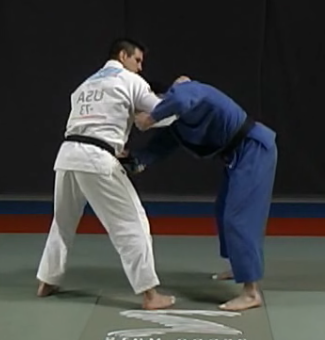
Which one of these guys is "winning?"

Thanks for stopping by! You're alright.
-Ben

Friday, August 19, 2011

Fall Judo Plans

Dr. Dad suspects minor MCL tear.
Since I'm stuck in bed for a few days due to an embarrassing ukemi-related injury, I figured I might as well use the time to think about Judo this Fall. Not just how often I'll be practicing, but what my goals are and where Judo will fit in my life now that I'm heading back to school. Summer is when we try as hard as we can to be the person we've always wanted to be. You know, the person who diets and exercises. The person who takes walks in the park when the mood strikes. The person that keeps in touch with old friends and family. Catch my drift? Those old slogans for "how to live a better life." In my case, this amounts to making every practice, every tournament, and really being there without having a 1,000 other things on my mind. It's a challenge- not like drought or famine or anything- but a challenge nonetheless.

Being a full-time student is a full-time job. A full-time job is also a full-time job, but hear me out. I'm very aware that what I have now, as a devilishly handsome 20-year-old Ivy League student, is the best situation I'll ever have. I don't know what a soul mate or child's laughter will bring, but as far as the amount of work I have to do vs. the amount of time off I get for it, I doubt that ratio will get better with time. What's scary to me is that even though I don't have mortgage to pay, kids to feed, or white picket fences to maintain I still have trouble finding time for Judo in my life. It's definitely not enough for what I want to achieve to go hardcore over the summer and then slack the rest of the year. Definitely not, but that's basically what I've been doing since I came back from my hiatus.

You know how when New Year's is around the corner and your inner monologue starts every other sentence with "This year will be different..."? I'm having that time now, even though I'm one of those cynics that will roll his eyes and say "Why not last year or the year before? You're not going to do it." That's a fair thing to say on my part, but I really hope that this (school) year is the year I can do it. I'm scheduled to teach 2 classes per week and "learn" one class per week at the Columbia Judo Club. That's one more than I did last year, so that should be good. I'm also planning to join the BJJ club (hopefully for a discounted price because their students crash my classes indiscriminately), and find a gym buddy to motivate me to start lifting again. I've planned this so I have people I depend on and people that depend on me to improve my technique and my conditioning. I'll let you guys know if this works out! School also happens.

Here are a list of tournaments I plan on attending in the next couple of months, Senior Men's Brown Belt <66kg for all.
  1. September 18th: 45th Annual East Coast Judo Championship - Newark, NJ
  2. October 2nd: 2011 Garden State Judo Classic - Wayne, NJ
  3. October 9th: Princeton Judo Invitation - Princeton, NJ
It's not annoying always going to NJ for tournaments or anything! Message/comment if I'll be seeing you there. I'll have photos/videos up, so look forward to some real content then.

Thanks for stopping by! You're alright.
-Ben

Monday, August 15, 2011

The Final Destination

Not a review of that awful movie series, sorry!

So here we are, at the end of my convoluted series of newaza articles. It's been a fun journey right? After all of the build up and time between posts, my solution is frustratingly predictable: cross-training in Brazilian Jiu-Jitsu (BJJ). Practicing a groundwork-focused fighting style if your groundwork isn't good enough? Brilliant Ben! Self-deprecation aside, there is some real thought that should go into this... While I refer to the general case of "groundwork-focused fighting style," I specify Brazilian Jiu Jitsu. This is the most logical choice for a judoka seeking focused newaza practice. Why? First of it, due to the rise of Mixed Martial Arts, schools are popping all over the United States and Canada. More importantly, BJJ comes from Judo so it's principles are the most compatible with the way a judoka moves and thinks. Off-balancing, efficiency, leverage, posture, position. The fact that both judokas and BJJ players associate those words with their style points towards this unique relationship and the ease with which one side should be able to train in the others'.

Any person who has spent more than 2 weeks in a dojo has come across the guy who "did some wrestling in high school and was pretty good at it." Even those types who are able to hold their own eventually get a "Fix your posture!" from Sensei, to which they respond "Sorry, I learned not to expose my legs." He'll fix it momentarily then a few minutes later will bend over again, causing frustration for everyone else on the mat (dramatization). What's working against this student are the incongruities between Judo and Freestyle wrestling. Freestyle or folkstyle? I'm not sure what they call it in high school, but cross-training it with Judo is demonstrably more difficult than cross-training BJJ with Judo. The posture is different, there's no gi, the definition of a pin is much more narrow that what constitutes a hold-down in Judo. Doing both isn't impossible (in fact, many top American Judoka wrestled in high school/college), but why not go for the easier transition?
He'll never tap!
This all seems simple enough, but one should still approach cross-training with caution. Again, I stress the importance of congruency. "Judo" should pair well with "BJJ," but the names are brands that anybody above a certain rank can use as long as they fill out the paperwork. This isn't necessarily me discrediting the 10's of thousands of teachers out there that I haven't met, it's just that there is clearly a difference in the way some choose to interpret the "ju" (gentleness) in "judo" and "jujutsu." If a sensei teaches you to muscle your way through a poorly timed throw, he's teaching you something- just not Judo. If a BJJ teacher tells you breaking closed guard is all about arm strength, he's teaching you something- just not BJJ. I'm not advocating going up to Sensei and challenge him to mortal combat to test his legitimacy. Not only is that rude, but the typical person seeking even intermediate level instruction isn't qualified enough to make that judgement. However, it is appropriate to be wary if your BJJ and Judo instructors are teaching you completely different concepts, when the two are supposed to be closely related.

While I definitely have more to say on this topic, I think I'll get off it for a while. I want to vary the content and style a touch more, but if you have any questions feel free to message me.

Thanks for stopping by! You're alright.
-Ben